“A portfolio can contain strong venture funds and still be badly constructed.”
In brief: Most venture conversations start with manager selection. We believe four decisions matter more, and come first: how much to allocate, how to diversify beneath the fund level, how to spread commitments across vintage years, and how to make sure the program can be funded through a full cycle. This article shares how we think about each.
Most venture conversations begin with manager selection: which funds have the strongest records, which are difficult to access, and which emerging managers may outperform. These questions matter - but in our experience, they come second. Before selecting a single fund, we believe family offices, high-net-worth individuals and institutional LPs benefit from deciding how venture capital fits within the wider portfolio: how much to allocate, how to diversify across managers and across time, and whether the program can be funded through a full cycle.
Access alone does not create a coherent portfolio. We have seen excellent funds combine into fragile programs because they were concentrated in the same companies, sectors, geographies or market environments. The attributes that define a durable venture allocation are largely invisible to manager-by-manager due diligence. But they are not unknowable.
The Size of the Allocation
In brief: Private equity averages around a fifth of family office assets, but venture deserves its own, smaller number. An illustrative starting point is 5–10% of investable assets. The right figure is the one you can hold when exits weaken and capital calls continue.
Goldman Sachs' 2025 family office survey reported that private equity - spanning buyout, growth and venture - accounted for 21% of family office assets. We would treat that figure as context, not a target. Venture is generally the most illiquid and power-law-driven corner of private markets, and the appropriate weight depends on each investor's time horizon, existing business exposure and ability to tolerate long periods without distributions.
As an illustrative framework, a new venture program might target 5–10% of investable assets. An exploratory allocation could begin at 3–5%, while an allocation above 10–15% generally calls for substantial surplus liquidity, strong governance and experience managing private-market commitments. These are starting points for portfolio design, not industry rules - and every investor's answer will differ.
What we find most useful is a simple reframing: the right allocation is not the percentage other investors have chosen. It is the percentage that can be maintained when exits weaken and capital calls continue.
Diversification Beneath the Fund Level
In brief: The gap between the best and worst European VC funds is enormous, and more fund names do not automatically close it. Real diversification lives beneath the fund level - in company overlap, stage, sector, geography and manager style.
PitchBook's benchmark for the 2023 European VC vintage reported an interim IRR of 59.5% for the top decile, compared with 4.5% for the median and negative 9.4% for the bottom decile. The vintage remains immature and heavily unrealized - but the dispersion shows how differently LPs can experience the same market environment. Two allocators, the same market, the same year, entirely different outcomes.
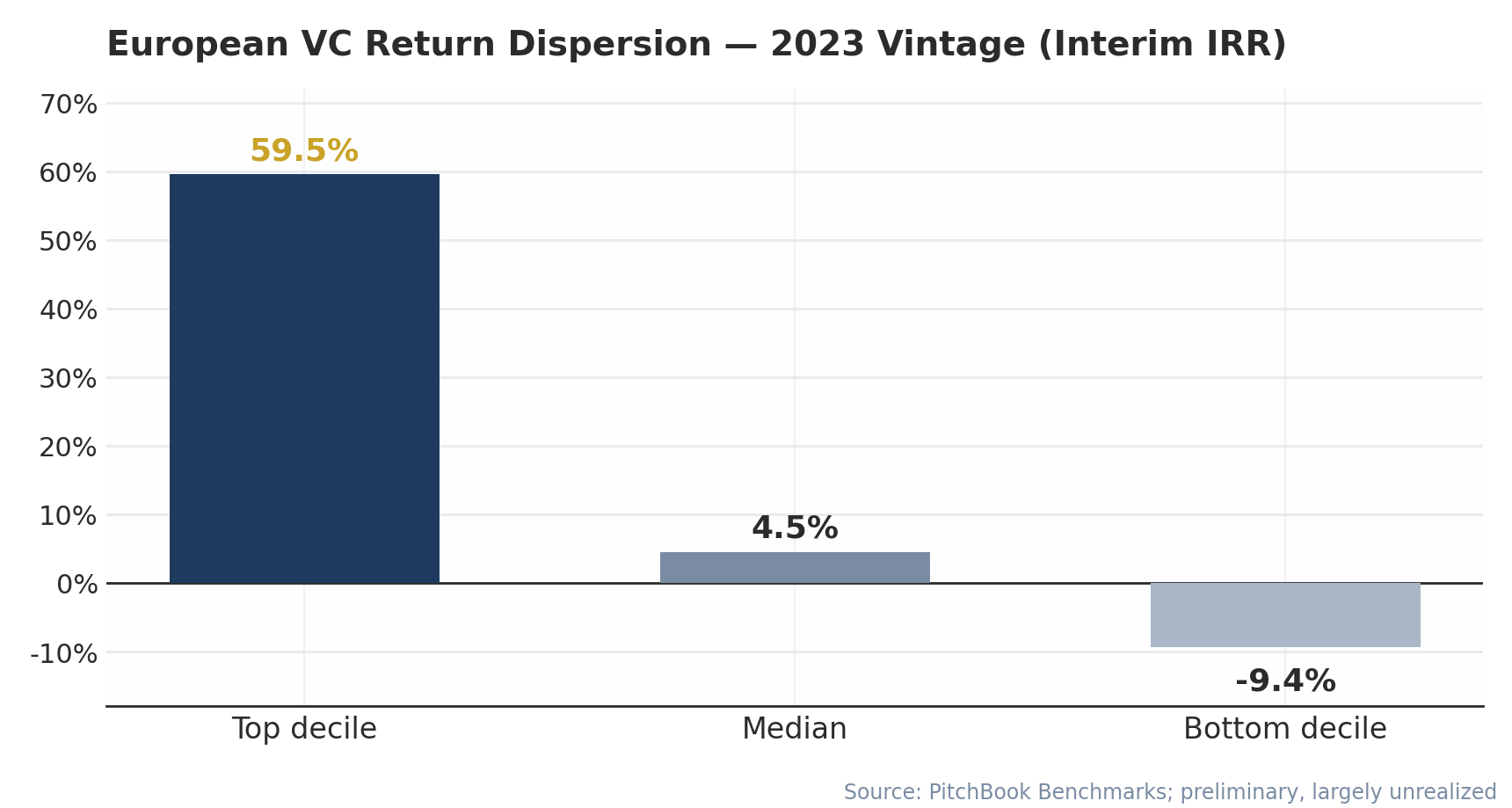
The instinctive response to dispersion is to accumulate more fund names. We would caution against reading that as genuine diversification. Ten managers may still invest in the same companies, follow the same themes or depend on the same exit market; a sleeve with a dozen logos can behave like a single position. We find it more useful to look beneath the fund level: underlying company overlap, investment stage, sector, geography, sourcing networks and manager style.
This analysis is labor-intensive, and it is one of the areas where structure helps. A fund of funds performs the overlap and portfolio-construction work across its underlying managers as a matter of course - it is, in effect, what the vehicle exists to do. For allocators building directly, as a working guardrail, a developing venture sleeve might limit any single manager to approximately 10–15% of the intended allocation. It also helps when every commitment has a defined role: a fund that adds no differentiated access, exposure or sources of return tends to add complexity rather than diversification.
Diversification Across Time
In brief: When capital is committed shapes returns as much as who receives it. Building the allocation across two to three vintage years, on a predetermined annual range, keeps one year's confidence - or fear - from deciding the whole program.
Manager diversification addresses who receives the capital. Vintage diversification addresses when it is committed.
PitchBook's pooled European VC figures illustrate the variation across cycles: 36.3% IRR for the 2016 vintage, 4.5% for 2021, negative 15.2% for 2022, and an early 16.3% for 2023, which remains preliminary. The same asset class, the same region - with outcomes shaped largely by the calendar.
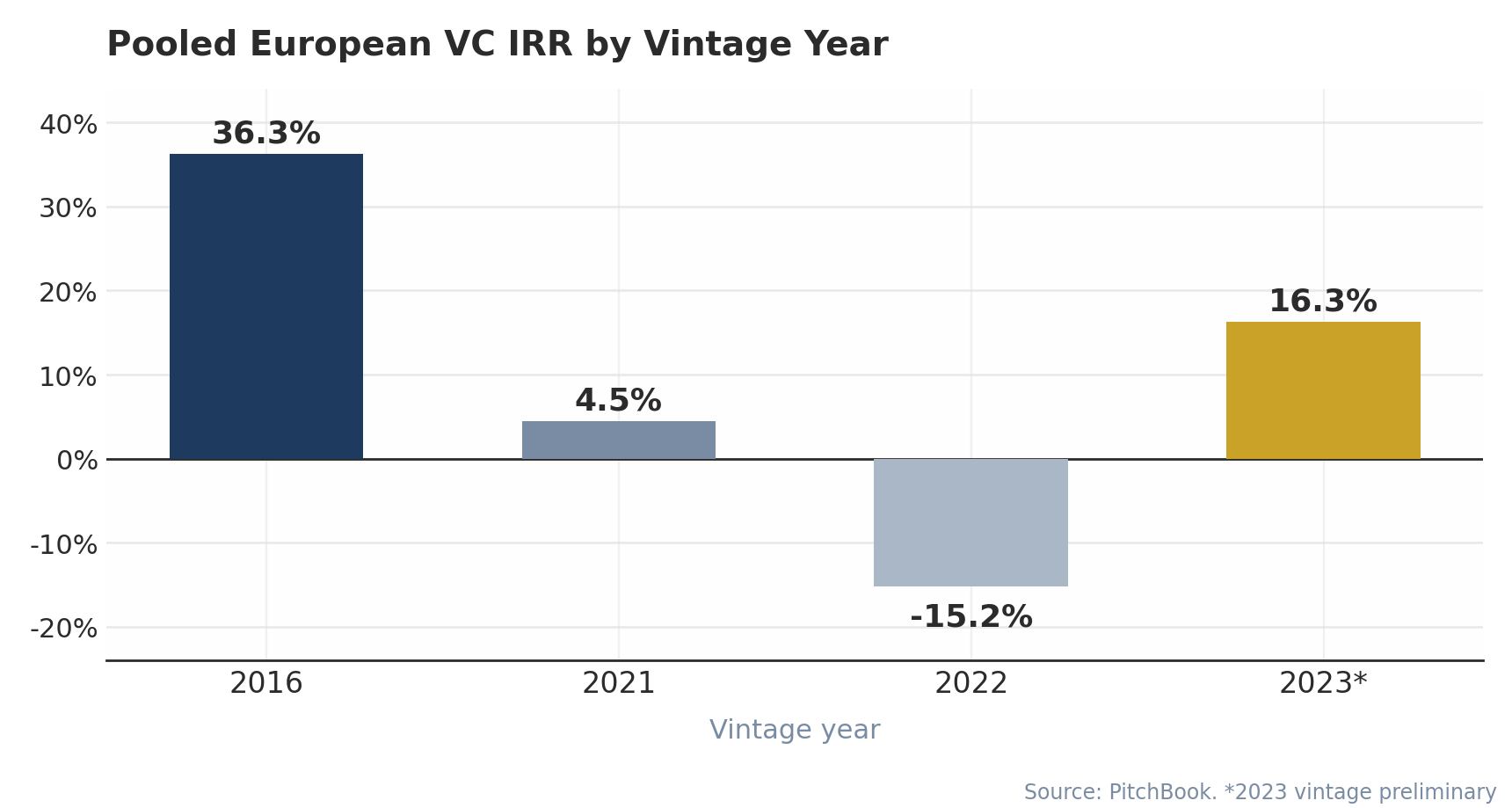
Vintage risk is not really about the calendar. It is about price. A sleeve committed entirely in 2021 entered at one valuation regime - and spent years marking it down. The fix is not to predict which years will be good. It is to keep committing, so the sleeve enters the market repeatedly: the correction, the trough, the recovery.
In practice, programs rarely lose this diversification through bad strategy. They lose it when the next commitment never happens - when weak distributions or nervousness interrupt the rhythm exactly when entry pricing is most attractive. Vintage breadth is less a selection skill than a funding discipline, which is why it leads directly to the commitment budget.
The Commitment Budget
In brief: A target allocation is not a commitment budget. Track NAV together with unfunded commitments, planned commitments and stressed liquidity - and agree in advance on what to do when coverage tightens.
A confusion we encounter often is between the target allocation and the commitment budget. The target is how much venture should eventually represent in the portfolio. The budget is how much can be promised to new funds each year while still meeting capital calls from earlier commitments. NAV alone can flatter a program: a portfolio may look comfortably below target while carrying large obligations not yet drawn. The figures worth watching together are NAV, unfunded commitments, planned commitments and stressed liquid assets - viewed over a rolling five-year horizon, so the years when calls could bunch become visible early.
The stress case matters most: distributions stay weak, funds keep calling, and listed assets fall at the same time. This is not hypothetical - the EIF Equity Survey 2025 found exits still limited and IPO activity at the lowest level in its survey series. Expected distributions should be treated as flexibility when they arrive, never as funding.
A practical test we like: stressed liquid assets divided by annual spending and capital-call requirements. Cambridge Associates maps three zones around this ratio - below two times is problematic, two to three times is cautionary, above three times is the safest range.
One further point: the response should be agreed before it is needed. If coverage tightens, slow new commitments - never default on existing ones or sell under pressure. If coverage holds, keep committing through the weak exit market. In our experience, this is how vintage discipline survives a full cycle.
Allocation Before Access
In brief: Five questions to answer before the first commitment - on size, role, implementation, diversification and fundability. Only then does fund selection begin.
Before the first commitment, we encourage allocators to be able to answer five questions:
1. What share of the wider portfolio should venture represent?
2. What role should the allocation serve?
3. How will it be implemented - building directly, through a fund of funds, or a hybrid of both?
4. How will it be diversified across managers and vintage years?
5. Can future capital calls be funded under difficult market conditions?
Only then, in our view, does fund selection begin.
European venture capital offers exposure to long-term innovation and genuine outliers. But access alone is not a strategy. From what we have seen, the sleeves that endure are sized honestly, diversified deliberately, built across years and supported by a commitment plan that survives the cycle.
This is also where structure matters most. The four decisions above are not difficult to state; they are difficult to execute without dedicated infrastructure - sourcing across fragmented European ecosystems, diligencing emerging and established managers, constructing across vintages and sectors, and monitoring a dozen underlying portfolios at once. A fund of funds with on-the-ground European presence converts that complexity into a single, governable allocation.
Lumen is built for precisely this: a Luxembourg-domiciled fund of funds focused exclusively on European VC across technology and life sciences, with the manager relationships to access funds that do not broadly market, and the portfolio construction to put the architecture of this article into practice on behalf of its investors.
The quality of the funds matters. The architecture around them matters just as much.