“The opportunity lies where Europe's best companies outgrow the capital around them.”
Europe's venture ecosystem has changed substantially over the past decade. Early-stage capital is deeper, managers are more specialised, and experienced founders increasingly recycle knowledge, networks and capital back into the ecosystem. Europe has become much better at creating venture-backed companies.
The harder question is what happens to the strongest of those companies as they mature.
Their financing needs grow quickly, but the capital available to support them does not always deepen at the same pace. For LPs, that mismatch shifts the focus from simply finding promising companies to identifying the managers with the access, judgement and networks to remain relevant as those companies develop.
Dealroom's 2024 data illustrates the imbalance. European companies raised $13.8 billion in rounds below $15 million, compared with $18.6 billion in the US. In $15–100 million “breakout” rounds, the difference widened to $22.5 billion versus $51.5 billion. At $100 million and above, Europe raised $18.1 billion compared with $120.8 billion in the US.
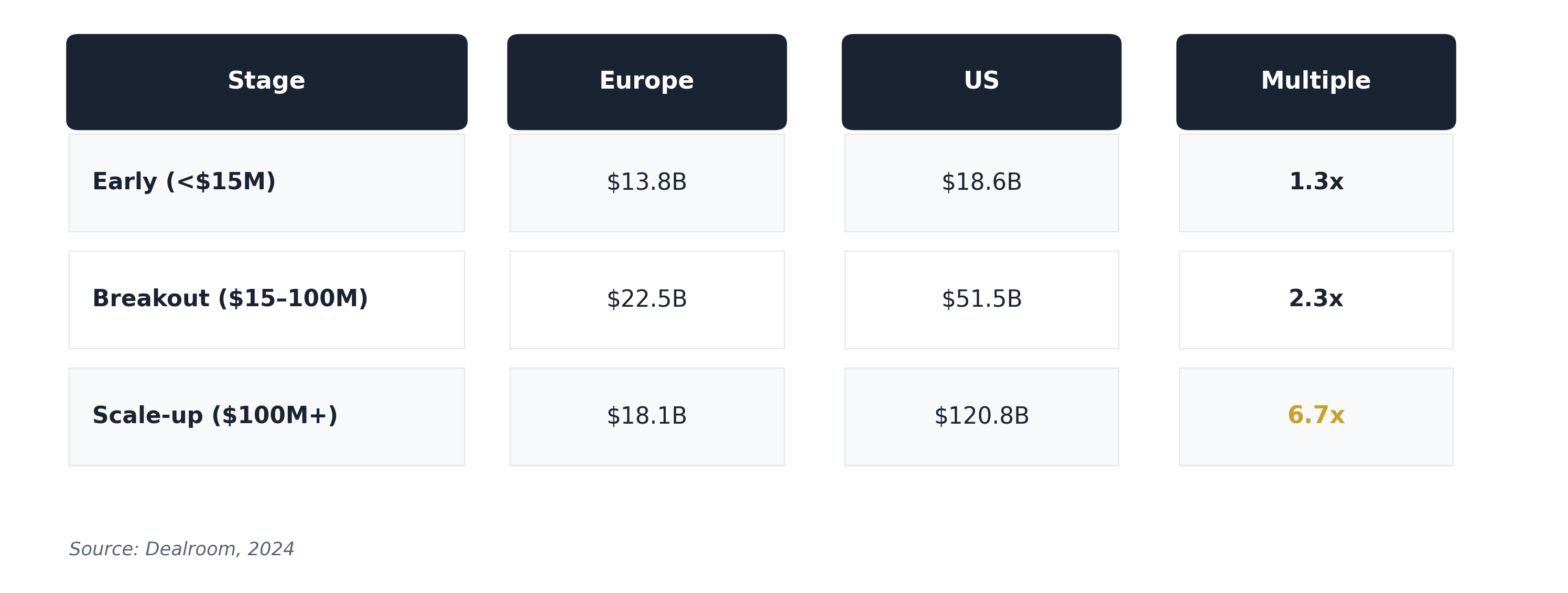
The important point is not simply that the US market is larger. It is that the relative financing gap becomes wider as companies require larger pools of capital. The European Commission similarly found that, for rounds above €50 million, there are at least seven times as many US as EU funds capable of participating.
For LPs, this raises a more useful question than whether Europe has “enough” capital:
Which managers are able to preserve their advantage as promising companies move from one stage of development to the next?
The Challenge Is Continuity of Capital
European venture is often discussed in stage buckets: Seed, Series A, Series B, Growth.
Companies do not develop quite so neatly.
An early-stage investor may identify a business before product-market fit and remain a shareholder for another decade. A specialist fund may have an advantage at a technical or regulatory inflection point. Another manager may enter later because its network, operating expertise or capital base becomes more relevant as the business internationalises.
What changes as companies mature is not simply round size. It is the type of capital and support they need.
Europe's domestic investor base remains strongest at the earlier end of that journey. As financing requirements increase, external capital becomes more important. This is particularly visible in capital-intensive sectors. Dealroom's 2025 analysis of European deep-tech and life-sciences spinouts found that European investors supplied approximately 86% of early-stage capital, while almost half of late-stage financing came from outside Europe, predominantly from the US.
Foreign investment is not a weakness. Global investors can provide deeper pools of capital, international networks and valuable scaling experience.
The vulnerability is dependence on that capital arriving at the right moment.
When global risk appetite is strong, the transition can appear seamless. When international investors retrench—as many did after 2021—the gaps between early financing, subsequent rounds and eventual exits become more visible.
For founders, that creates funding friction. For LPs, it makes a manager's ability to navigate the full financing ecosystem more valuable.
The Opportunity Is Not a Particular Stage
It would be easy to interpret Europe's capital imbalance as an argument for allocating more money to Series B, Series C or growth funds.
That misses the more interesting point.
Capital scarcity does not automatically produce attractive investments. Europe's most sought-after companies—particularly in AI, defence, deep tech and life sciences—can attract intense global competition and premium valuations well before they reach conventional “growth stage”.
The potential inefficiency appears when company progress and investor recognition move at different speeds.
A company may have achieved an important technical milestone, demonstrated commercial traction or entered a much larger addressable market without yet becoming an obvious global winner. An existing investor may have privileged knowledge through years of involvement. A sector specialist may understand the significance of the progress before a generalist investor does. Another manager may have the relationships required to bring the right capital into the next round.
The opportunity therefore sits less neatly within a particular Series A, B or C cheque than in the transition from early promise to durable scale.
And that makes it primarily a manager-selection question.
What Should LPs Look For?
For LPs, stage labels reveal only part of the picture. The more important question is what advantage a manager retains as its portfolio companies develop.
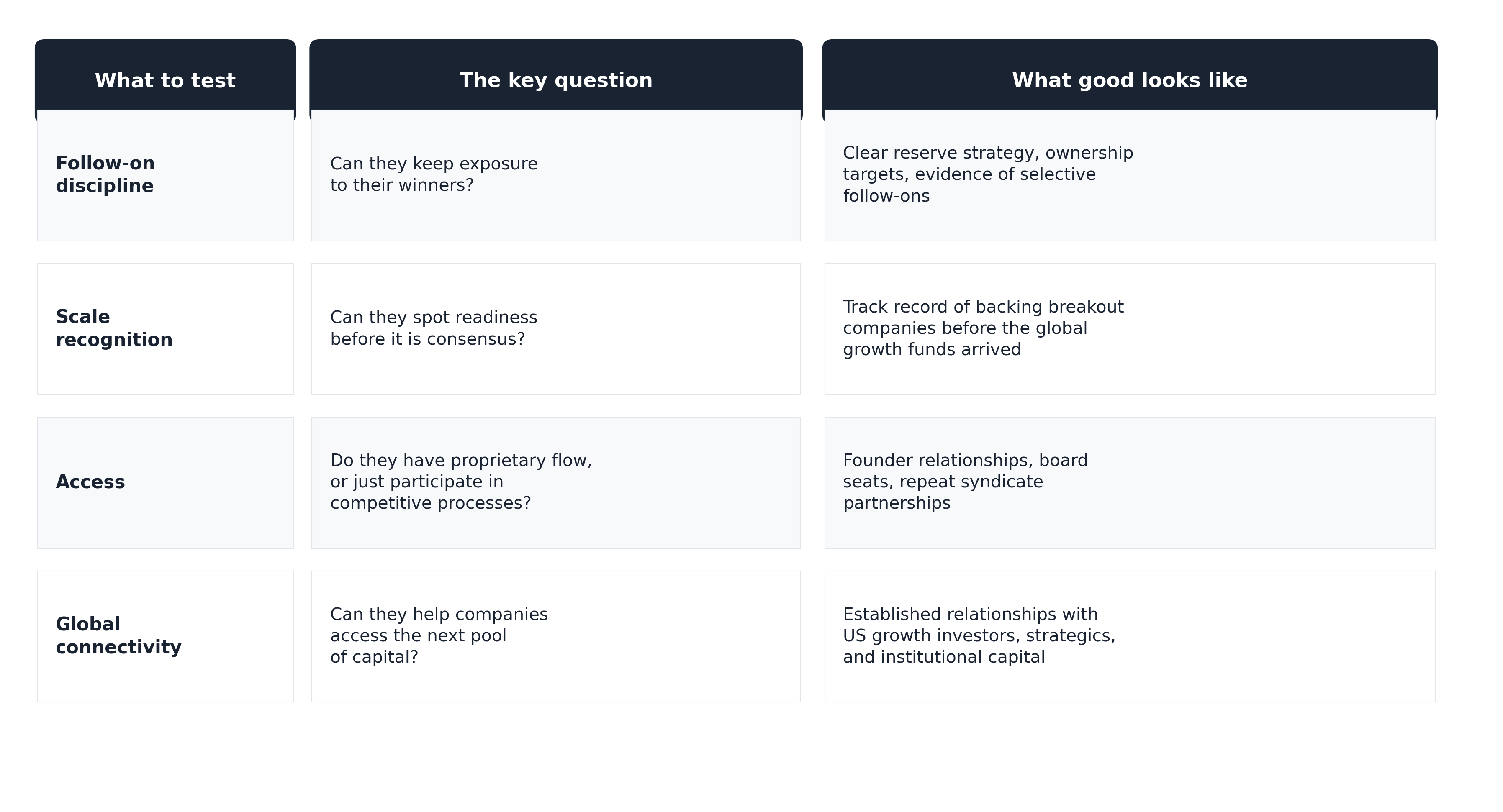
The strongest manager does not necessarily need the largest fund or the capacity to finance every subsequent round.
In many cases, a more valuable capability is knowing which companies deserve additional capital, how much exposure to retain, and which investor should come next.
This also changes the way diversification should be understood. A portfolio of managers labelled Seed, Series A and Growth is not necessarily diversified if they ultimately depend on the same companies, sectors or networks. Conversely, several early-stage managers can play very different roles if their sourcing, specialist knowledge and follow-on strategies are genuinely differentiated.
The Market Is Evolving
Europe's missing middle should not be mistaken for a permanent capital drought.
Large rounds have returned strongly. In the four quarters to Q2 2026, 54% of European venture investment went into $100 million-plus rounds, with 30% going into $15–100 million rounds and 16% into rounds below $15 million.
The scale of individual financings is also changing: Dealroom counted 96 European rounds of $100 million or more between January and August 2026, raising $33.3 billion across sectors including software, robotics, energy and life sciences.
So the thesis cannot simply be that Europe lacks growth capital.
The more durable observation is that capital depth remains uneven across companies, sectors and markets, while Europe itself remains fragmented. The financing path for a biotech company is fundamentally different from that of an enterprise software business. A deep-tech company may require substantial capital before commercial scale, while a software business may reach international revenues with far less.
This complexity increases the value of specialist knowledge and local access.
What This Means for LPs
For LPs, Europe's missing middle is therefore not an argument for mechanically allocating more to growth.
The more important portfolio question is whether the selected managers provide continuity of access to exceptional companies as they develop.
Some managers will identify those companies early. Others will understand particular technical or commercial inflection points. Some will retain ownership through multiple rounds, while others provide differentiated access later. What matters is how those capabilities complement one another—and whether each manager contributes something genuinely different to the overall portfolio.
This is also how we think about the opportunity at Lumen Partners. When evaluating European managers, we look beyond stage labels to understand sourcing advantage, follow-on discipline, underlying company overlap and the role each manager can play as companies evolve.
Europe's missing middle is not an investment thesis by itself. Capital scarcity does not automatically generate returns.
But an uneven financing market can make access, judgement and portfolio construction more valuable.
For LPs, the opportunity is not simply to invest before more capital arrives.
It is to back the managers capable of staying relevant as Europe's best companies grow.
Sources: Dealroom.co (2024 full-year, 2020–2025 capital nationality averages), Atomico State of European Tech 2023/24, European Commission Study on Venture and Growth Capital Funds (2025), ECB Economic Bulletin (2026).